The most powerful question we can ask—of ourselves, of others, of the world—is deceptively simple. That question is:Why?
It’s the question that births clarity, disrupts conditioning, and reclaims autonomy. And ironically, it’s one of the first questions we’re punished for asking.
You know how three-to-six-year-olds are—relentless, curious, unfiltered? Their questioning quickly escalates.
Why?
Why?
But whyyyy?
If you were lucky, your early “whys” were met with thoughtful answers. There was someone there to explain—maybe not all of the time, but most of it.
Unfortunately, for many of us, our “whys” were shut down with a sharp, finalizing:
“Because I said so!”
This is where the conditioning begins. We learn—consciously or not—that someone else’s word is law. That authority equals truth. That questioning is defiance.
Usually, this message comes from someone we love and depend on—a parent, grandparent, teacher. They’re the boss. It’s their house, their rules, their game. And so we adapt. We stop asking why—at least out loud. We internalize their truth and try to mold ourselves around it.
My Journey to Reclaiming Autonomy and Truth
I stopped trusting my own truth around age 14. I just wanted to be normal. I didn’t want to be shamed anymore. I wanted to fit in, so I forfeited my autonomy and began to blend in with my environment.
I laughed at jokes that made my stomach turn. I stayed silent when someone’s behavior felt off. I dated people I had little in common with—but you wouldn’t have known it. I mirrored their interests, their language, their worldview. I made their preferences mine.
By the time I moved out at 18, I was primed to accept the truth of any perceived authority figure. That’s part of what makes trauma survivors such easy targets for manipulation, cults, and coercive systems. Thankfully, I was spared from the cults—but I still experienced manipulation and was affected by coercive systems.
Before long, everything started to feel wrong: misaligned and uncomfortable. Depression crept in.
Daring To Ask
One day, as I was lying in bed, marinating in my despair, I dared to ask myself the forbidden question:
“Why am I feeling this way?”
At first, the answer was vague, though mildly annoyed:
“I don’t know!”
Which, in that moment, sounded a lot like “Because I said so!”
But I didn’t stop there. I was tired of feeling miserable, and I needed to know the reasons behind it. So, I channeled my inner four-year-old and kept asking:
“But why?”
It took a few tries and convincing, but eventually, something shifted. I cracked through the surface. I heard the defeated voice say:
“I guess I’m lonely.”
And that sparked a revolution. It felt like there was hope after all: “If I can understand it, I can fix it.” (As a side note,that mindset is actually another one of my trauma responses and isn’t always helpful, but in this case, it happened to be the drive I needed.)
So, I leaned into it with compassion and curiosity.
“Why are you lonely, Ash?”
“Because nobody understands.” I heard the voice say.
From there, I kept peeling back the layers. Each “why” unearthed another truth. Another wound. Another unmet need. And with each answer, I reclaimed a piece of myself.
Why Asking “Why?” Is Essential for Self-Trust
When we forget to ask why, we surrender our lives to someone else’s narrative. We outsource our discernment. We trust their judgments, their opinions, their feelings—over our own.
This creates a rupture in our inner compass. It makes us vulnerable to gaslighting, manipulation, and emotional abuse. It erodes our autonomy and places our sense of self in the hands of false authority.
Let me be clear: I’m not saying we’re above the law or immune to consequences. I’m talking about the everyday figures we’re conditioned to obey without question—bosses, parents, friends, political leaders, celebrities, doctors, CEOs.
No one has authority over our inner truth. No one is authorized to tell us what to believe in, what to like, or what to care about. That authority is ours and ours alone.
Reclaiming the Question: An Act of Self-Trust and Rebellion
Asking “why” is an act of rebellion, of healing, and of self-trust.
It’s how we unlearn the scripts we were handed, write our own, and begin reclaiming our autonomy. It’s how we stop performing and start living. It’s how we move from survival to sovereignty.
So ask it. Loudly. Quietly. Relentlessly.
Why do I feel this way? Why am I tolerating this? Why do I believe that? Why did I stop trusting myself?
And when the answer is “I don’t know,” ask again.
Because somewhere beneath the silence and frustration, your truth is waiting to be heard.
As always,
Be Gentle. Go slow. Peel better. 🍊
If any of this resonates with you, know that healing is possible. Here are a few places to start:
Below is a piece I wrote in mid-2024. It marked a moment of clarity for me. I finally understood all of the ways fear was directing my path. But not in the ways I wanted, since writing this, fear has remained a compass, but instead of holding True North, I’ve allowed it to guide me to places I never thought possible.
By approaching the things that scared me through the lens of curiosity and excitement:
I’ve expanded my knowledge by taking classes I was previously afraid to take.
I’ve experienced new things, like traveling and immersing myself in new cultures 🇲🇽.
I’ve learned more about myself, such as what I need and want from life.
I hope this can encourage you to let fear guide you in a new way.
The Compass of Fear: Doing it Scared
06/12/2024
I’ve lived in a constant state of fear. Fear of failure, fear of success, fear of abandonment; fear is in every decision I make, and especially the ones I don’t. Fear keeps me frozen in time. For my entire life, I have altered my actions and behaviors out of fear of not being accepted by others. I never stopped to question whether they were people by whom I wanted to be accepted.
It’s exhausting pretending to be something you’re not. Even when you’re not fully aware you’re doing it. I would push the uncomfortable feelings down, the ones that told me something wasn’t right. Because I felt so broken and misunderstood, I worked extra hard to understand others. To the point I could make excuses for their actions to convince myself things were okay. Never questioning whether it was the type of behavior I wanted to surround myself with.
I lost myself in fear. I lost the things that I enjoyed, my values, and my dreams. I replaced them with the passions of others. I sat around wondering why I couldn’t seem to stick with a hobby. It never occurred to me that the hobby wasn’t mine. I spent so much time trying to fit a mold that was not meant for me.
Just as the fear hurt me, it also helped me to hurt others. By pretending to be something I was not, I manipulated my relationships. By not being honest about my needs and wants, I created confusion and distrust. By saying yes when I meant no, I built false resentments. Relationships require vulnerability, honesty and intimacy. None of which fear allows.
I don’t want to be afraid anymore. I want to open myself up and show people my favorite parts. I want to be honest in my relationships and with myself. I wish it was as easy as saying it, but I’m still uncovering these parts of me that were buried so deep. I’m just now remembering who I am, and I can’t be honest until I know my truth.
I’ll continue searching for myself because I believe she’s worth it. But also, because I think others deserve it. They deserve the best parts of me, the genuine parts. Not just the parts I built to please them. And since fear doesn’t come with an on/off switch, I will be doing it scared, turning anxiety to excitement.
Part 4 of a 4 part series on Grief, find more here.
I mourned who I used to be, until I realized she was never fully whole. She was stitched together by expectations, silence, and survival.
Understanding the Unspoken Mourning of Self
I expected separation and the end of relationships would involve grieving, but I never imagined how layered that experience would be. As we’ve explored in our grief series, there’s a lot more to grief than dying. But did you know there’s also a lot more to it than grieving the loss of other people and things?
I knew I would be grieving the absence of my husband and relationships within that marriage, after all, they had been a large part of my life and routine. I expected to feel loss there, to feel an emptiness. What I didn’t expect was to feel like I was lost myself.
After my marriage ended, I didn’t just grieve my husband and relationships associated with our union, I felt the loss of the version of me that existed within those relationships. The wife, the caretaker, the cook, the lover, and the partner. I sank into a depression, no longer recognizing my reflection in the mirror. I felt like a sailboat with no wind for my sails, like I was built for motion but stuck, stagnant.
And when I began to examine who that version of me really was, I uncovered a deeper truth: she wasn’t just lost, she had never truly belonged to me.
Personal Experience: Grieving Identity Loss in Relationships
For most of my adult life, I identified myself through my relationships. I was someone’s partner, someone’s emotional anchor, someone who existed to meet others’ needs. I didn’t just love, I performed love. I sacrificed, accommodated, and shape-shifted to keep the peace. I said yes when I meant no. I stayed silent when I wanted to speak. I believed that if I set boundaries, I’d be abandoned.
I wasn’t taught boundaries growing up. My emotional, physical, and social limits were crossed repeatedly in childhood and early adulthood. So, when I entered relationships, I didn’t know how to protect myself; or that I was even allowed to. I thought my people-pleasing was love. And in a way, I guess it was. It was the only love I had ever known. One based on performance and availability. A love that required me to disappear.
It wasn’t until my marriage ended and I began unpacking the patterns beneath it, that I realized how deeply I had betrayed myself. I felt guilty for the ways I had deceived my partners by pretending to be okay. I felt ashamed for saying yes when I meant no. And I felt devastated by the pain my compliance had caused. Not just for me, but for the people I loved.
Then came victimhood. I felt taken advantage of. Used. Unseen. But that quickly spiraled into guilt again, because hadn’t I allowed it? Hadn’t I taught people to treat me this way? Didn’t I grant them permission?
It was a brutal emotional pendulum, swinging between blame and shame, betrayal and responsibility. But somewhere in that chaos, I uncovered two things that shifted my mindset—
I did have a choice.
I had a responsibility, to myself and others, to make a different one.
Grieving the loss of my relationships was hard. But grieving the loss of identity I had built within them—that was harder. Because that version of me wasn’t just gone. She never fully existed to begin with.
Identity grief: the mourning of a self that no longer exists or was never truly authentic.
Grief isn’t always about losing someone else; sometimes it’s about losing yourself or realizing you never had the chance to become who you were meant to be. This is especially true when a version of you was built on survival—masking, people-pleasing, and self-erasure. When we lose a relationship, we often lose a self we thought was real. The grief becomes even more complex because the absence of a partner is also the absence of the identity you performed to keep them.
🧠 The Pain of Identity Disruption
Our identity is our lifelong companion. It’s how we understand ourselves, make decisions, and connect with others. When that sense of self is disrupted, especially after trauma or relational loss, it can feel like our one and only lifelong partner has vanished. We feel empty, disoriented, and alone. We question our reality, our past, and our worth.
In healthy environments, identity forms through exploration. Trying new things, expressing preferences, setting boundaries. But in dysfunctional homes, identity often forms through adaptation and survival—
What can I do to make them happy?
How can I stop the fighting?
What will earn their love and attention?
Self-expression is shamed. We’re told our music, clothes, body, or voices are wrong. And we begin masking. We present ourselves in ways that feel acceptable, not authentic. We shrink to fit the mold others expect. And over time, we forget who we are.
Even as adults, this pattern can live on. I’ve found myself staying quiet when meeting someone new, scanning for cues about how they want me to show up. I’ve withheld my truth to avoid rejection. I’ve shaped myself to fit their comfort; not mine.
Research on Identity Loss and Grief
Recent studies confirm that identity disruption is a core component of grief. Especially in cases of relational loss, divorce, and prolonged grief:
• A 2021 study published in Current Psychology found that merged identity with a partner was a key predictor of prolonged grief symptoms. When our sense of self is deeply entangled with another person, their absence destabilizes our emotional and cognitive functioning [1].
• Research from Antioch University highlights the concept of non-death grief, especially in marginalized communities. It shows that loss of identity—whether through gender shifts, trauma, or relational rupture—can trigger grief responses as intense as bereavement [2].
• A 2018 study in the Journal of Loss and Grief found that a disrupted sense of self after bereavement is a key predictor of more severe and prolonged grief symptoms [3].
These findings validate what many trauma survivors feel but struggle to explain; that losing a version of yourself, especially one built on survival, is a legitimate and painful form of grief.
The Invisible Grief of Identity Loss
Identity grief is often dismissed or overlooked because there’s no tangible loss. No funeral. No obituary. But if you’ve experienced it, you know; it’s one of the most disorienting and painful losses you can feel.
It can trigger:
• Emotional flashbacks
• Depression and anxiety
• Dissociation and self-doubt
• A pendulum between guilt and victimhood
And yet, it’s a grief only you can see. Only you can feel. If you’re lucky, you’ll have friends who notice the shift and support you as you peel back the layers and meet your truest self.
Rediscovering Self: Healing from Identity Loss
Reconnection to self is possible; but it requires patience, compassion, and a willingness to sit with discomfort. After years of performing roles that weren’t truly mine, I’ve found the most powerful way to reconnect with my authentic self is through journaling and meditation.
Some days, it’s directionless. I write freely or sit quietly. Other days, I need encouragement, a prompt, a question, or a gentle nudge. You can find some of my favorite journaling prompts here. They’ve helped me meet myself in ways I didn’t know were possible.
Therapy has also been a cornerstone of my healing. I’ve been in consistent therapy for five years, and it’s guided me when I couldn’t guide myself. Anonymous support groups have offered a different kind of safety—less pressure to perform, more space to witness and be witnessed. Vulnerability isn’t always about sharing with others. Sometimes, it’s about sharing with yourself. And if you don’t feel safe within yourself, your inner parts will keep you stuck.
• What parts of me feel most alive, even if they’ve been quiet lately?
Don’t rush the process. Give yourself grace. Like all healing, rediscovery isn’t linear; it’s layered, tender, and often surprising. But with time, you’ll begin to uncover parts of yourself you’d forgotten. Parts that bring joy. Parts that feel like home.
My Personal Journey of Self-Rediscovery
I re-discovered my love of writing and blogging last year. You can read more about that in my Medium article, The Hard Peel of Identity: How Creating Helped Me Meet Myself. These were parts of me I had buried to focus on performing in my relationships. Had you asked me three years ago, I would’ve told you I had no hobbies. Nothing stuck. That’s because I was trying on the hobbies of other people, not my own.
It took time. It still requires maintenance. But I feel more connected to myself than I ever have. I feel confident. And I feel more secure in my worth.
Navigating Setbacks in Identity Healing
It’s not always sunshine and rainbows. Rediscovery doesn’t mean you’ll never struggle again. A little over a month ago, I fell back into depression. I felt like all my hard work had been for nothing. I was stuck in an emotional flashback, incapable of caring for myself in even the smallest ways.
It took writing this series, multiple support group meetings, therapy sessions, and intense journaling to reignite my spark. But having those tools meant everything. What could’ve been a downward spiral that lasted weeks, months, or years was interrupted.
Healing isn’t about perfection. It’s about curating the tools and behaviors that guide us out of the dark—the ones that save us from falling into the deep end when we’re slipping.
Coping with Identity Grief: Tools & Resources
Rediscovering yourself after identity loss isn’t just emotional—it’s somatic, spiritual, and practical. You’ll need tools that meet you where you are, especially on the days when clarity feels far away. Below are a few methods I’ve used to reconnect.
🛠️ Practical Tools for Identity Reconnection
• Journaling: Free writing, guided prompts, and identity mapping
• Meditation: Breath-led grounding, visualization, and body scans
• Movement: Trauma-informed yoga, stretching, and walking
• Support Groups: Anonymous spaces for shared vulnerability
• Therapy: Consistent guidance and emotional regulation
You don’t need to use all of them. Just start with one. Let it be gentle. Let it be yours.
I’ve curated a full page of downloadable resources to support you—PDFs with journaling prompts, meditation guides, breathwork rituals, and more. You can explore them here. You’ll also find my favorite podcasts, affirmations, and reflections to help you feel less alone.
If you’d like even deeper support, you can sign up for my email list and receive a free Recovery Toolkit—a collection of healing tools designed to help you reconnect with yourself and move through grief with compassion.
Embracing Your Becoming: A Gentle Invitation
Grief and identity loss are not just events, they’re emotional landscapes. And rediscovery isn’t a destination, it’s a practice.
If you’re feeling lost, fragmented, or unsure of who you are without the roles you once played, know this: you are not broken. You are becoming.
You are allowed to change.
You are allowed to return to yourself.
You are allowed to heal on your own terms.
Let this be your invitation to begin.
To meet yourself with softness. To peel back the layers and find what’s true.
Be gentle. Go slow. Peel better. 🍊
Sources
Merged Identity and Prolonged Grief Symptoms Current Psychology (2021) It’s not who you lose, it’s who you are: Identity and symptom trajectory in prolonged grief
Non-Death Loss and Identity Grief in Marginalized Communities Antioch University Dissertation (2024) The Grief of Identity Formation: How Non-Death Loss Complicates Trans Identity Narratives
Neimeyer, R. A., Klass, D., & Dennis, L. (2018). The death of a “self”: Identity disruption and the experience of grief. Journal of Loss and Grief, 22(1), 1-17.
Part 3 of a 4 part series on grief, find more here.
Processing grief isn’t about finding a fix, though we often want it to be. We want to make it go away; to pack it neatly in a box in the back of our minds to never bother us again. But that’s not what grief wants or needs. Grief wants a companion. It needs someone to sit with it in the dark, to feel the tragedy, the agony, and the despair. Grief needs someone to bear witness to its pain and to move through what cannot be fixed.
Grief is the echo of all we’ve lost. We honor it by listening.
—Ash Elizabeth, The Hard Peel
It comes in waves because if it hit all at once, it would wipe us out completely. The waves sometimes feel like tsunamis; fortunately, we’re still able to come up for air in between crashes. We welcome those moments of reprieve because, for grief, time doesn’t exist. For some of us, it can even feel permanent. One thing I’ve learned from grief is that it doesn’t want answers, explanations, or justification. And it doesn’t need structure or routine. It only wants our presence, and it needs our acknowledgement.
Exploring Your Grief: Practical Tools for Healing
If you’re currently processing grief, it can feel overwhelming to even know where to begin. The goal isn’t to get rid of your pain, but to create a space to move through it. Below are some powerful tools that can help you explore your grief and find a way to honor it.
How to Process Grief Through Journaling
Journaling is a powerful tool for exploring grief. It doesn’t require you to talk to anyone. You don’t have to share openly; it’s a way you can be completely honest about your feelings without fear of judgment or repercussions. Research shows that writing about stressful and traumatic events can lead to significant improvements in both physical and psychological health, reducing symptoms of anxiety and depression [1, 2].
Try asking yourself these questions:
What else did I lose beyond the obvious?
What parts of me feel different since the loss?
What do I wish I could say to them, to myself, or to others?
What does my grief need from me today: rest, expression, silence, or even laughter?
Finding Healing Through Creative Expression
Another way to work through grief is through creative expression. Art provides a healthy outlet for the uncomfortable emotions we’re experiencing. Whether you’re writing, painting, or dancing to your favorite music, expressing yourself is a perfect way to process grief. Engaging in creative arts therapies has been found to be effective in reducing symptoms of anxiety and depression, providing a non-verbal outlet for complex emotions [3, 4].
You might try some of these methods:
Create a photo collage or memory box.
Try nature photography.
Paint or draw whatever comes to mind.
Write poetry or short stories.
Grounding Your Body with Grief Practices
Grief is felt in both the mind and the body. Engaging your senses and bringing awareness back to your body can help prevent you from getting stuck in a cycle of grief. Slow and gentle movement will allow your body to process uncomfortable feelings instead of holding on to them. Studies show that incorporating physical activity, even gentle movement, can significantly reduce symptoms of depression, anxiety, and stress by boosting mood-lifting endorphins and regulating the nervous system [5, 6].
Try some of the ideas below to help regulate your nervous system while grieving:
Stretching
Walking
Somatic grounding & breathwork
Vocal release, such as humming, singing, or even yelling into a pillow
Why Talking It Out Can Help You Grieve
Sharing your grief can restore a sense of connection and community. Finding a trusted therapist, leaning on friends, or joining a support group can help you feel less alone. Research suggests that group support can reduce feelings of isolation and stress, provide emotional relief, and foster a sense of understanding [7, 8]. For more complex grief, targeted therapies have shown high rates of effectiveness in helping individuals restore functioning and find new ways to think about their loss [9].
If you’re grieving, ask a friend to meet you for a cup of coffee or a walk. Sometimes, simply saying the words out loud can be a huge step forward.
Finding Comfort in Spiritual Reflection
Spiritual reflection doesn’t have to be religious, though it can be. It’s about leaning into your personal belief system—whether that’s God, the universe, or a set of rituals you’ve developed for yourself. Find what brings you internal peace during your time of grief and lean into it. Spirituality and religious rituals can offer powerful coping mechanisms, providing comfort, meaning, and a sense of connection during times of profound disorientation [10].
This might look like:
Prayer
Rituals, such as lighting a candle or visiting a meaningful place
Meditation
Connecting with spirit guides or your higher power
My Journey with Grief
Twelve years ago, I sat on the edge of my bed as my heart was ripped out of my chest. Agony consumed me as I learned that my best friend, pregnant at the time, had been in a horrendous accident the night before. She was on life support, and it was time to say goodbye. Despair radiated through my body as my friend and her unborn son were suddenly ripped from this earth. It was the greatest heartbreak I’ve experienced to date.
In the days following her death, family and friends gathered around to support me. We brainstormed ways I could document what she meant to me. I still remember the poster I made for the funeral. It was covered in photos of her and me, decorated with her favorite colors and patterns. In the center were words I wrote expressing how much her friendship meant to me.
Six months later, the waves were still crashing. I found myself sitting by her grave, catching her up on life between my sobs. My partner couldn’t understand why I wasn’t “over it” yet. I’m sure six months seems like a long time to someone who hasn’t lost anyone close to them. But to anyone who’s ever lost someone they loved dearly, someone they spent nearly every day with, six months is nothing. Instead of pushing the grief down, I began sharing on an anonymous online platform and later in therapy.
No single action I took alleviated the pain of loss. But together, they helped me process and move forward. They allowed me to accept, express, and feel the complex emotions associated with the sudden death of my best friend. I still feel the sting from time to time and will even shed a tear or two for the future, the identity, and the lives that were lost that day.
Significant losses have marked my life. Some were public and what some would deem “acceptable,” like losing my best friend and her unborn son. Others I felt I couldn’t speak freely about, like the demise of my marriage, which I’m still processing through therapy and anonymous support groups. Then there were things, like my miscarriage, that I grieved alone, with the help of journaling and my higher power. With each loss, I clung to these foundations, finding solace and a way to move forward.
A Final Encouraging Note
Grief is a heavy and difficult road, but you don’t have to carry it alone. You are not meant to “get over” your grief, but to learn how to carry it. Research on grief consistently shows that actively engaging with your emotions and seeking support are powerful ways to heal. Be gentle with yourself. Your grief is a testament to the love you have, and that love is a beautiful, powerful thing.
The path of grief is unique for everyone, but these tools offer proven avenues for processing, healing, and ultimately, integrating your loss into your life in a meaningful way.
How have you navigated grief in your life? I’d love to hear your experiences in the comments below.
Baikie, K. A., & Wilhelm, K. (2005). Emotional and physical health benefits of expressive writing. Australasian Journal of Psychiatry, 39(12), 1083–1090.
Pennebaker, J. W. (2000). Expressive writing: Connections to physical and mental health. In H. S. Friedman (Ed.), The Oxford handbook of health psychology (pp. 521–539). Oxford University Press.
Taylor, A. J., & Graham, J. A. (2006). The use of art therapy with bereaved children: A qualitative study. Art Therapy: Journal of the American Art Therapy Association, 23(2), 79-85.
Stewart, S. L., & Neimeyer, R. A. (2014). Creativity and loss: Art as a medium for grief work. The Journal of Transpersonal Psychology, 46(1), 74-94.
O’Connor, M. F. (2019). The neuroscience of grief. Current Opinion in Psychology, 30, 148-152.
Sweeney, A., & O’Connor, K. (2018). The role of physical activity in the management of grief. Death Studies, 42(10), 651-659.
Charlie Health. (2025). Group support might help you cope with grief, data shows.
Jordan, J. R., & Neimeyer, R. A. (2003). Does grief counseling work? An empirical review of the effectiveness of grief interventions. Grief Counseling and Grief Therapy, 4, 143-167.
Shear, M. K., Frank, E., & Foa, E. (2008). Traumatic grief: A conceptual and clinical review. Dialogues in Clinical Neuroscience, 10(2), 173–182.
Tix, A. P., & Frenk, J. M. (1991). Coping with bereavement: The role of spirituality and religious beliefs. Journal of Clinical Psychology, 47(1), 1-13.
Part 2 of a 4 part series on Grief, find more here.
Over the past year, my world didn’t just crack, it shattered. It wasn’t just a single event, but a relentless culmination of losses. My identity, my stability, my core relationships, and future dreams faded away. And despite my best efforts, I wasn’t prepared for the emotional wreckage I would be left with. I found myself dazed and confused by all of the feelings. I didn’t recognize it at first, because it didn’t look like “grief” as I knew it. There was no funeral, no single marker, just a quiet unraveling of self. What I thought was consequences of a wrong decision, was something far more complicated. It was compound grief; the silent, overwhelming weight of grieving everything, all at once, without a clear end in sight.
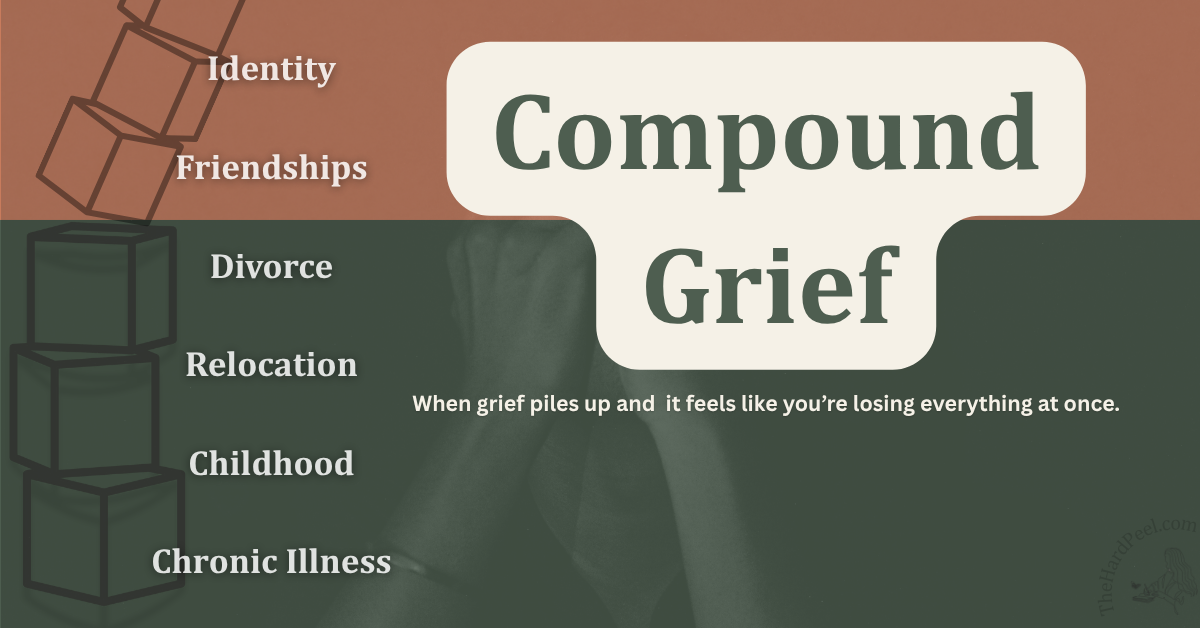
Compound grief, sometimes called cumulative grief, isn’t the single shot to the heart we typically understand. It’s an emotional avalanche, triggered by multiple losses piling up. Often these losses happen in rapid succession or before you’ve had a chance to process the one before. Think divorce, job loss, relocation, the quiet death of friendships, or even shifts in identity and purpose.
Unlike the focused sorrow after death, compound grief arrives subtly. It disguises itself as persistent burnout, irritability, and internal resistance. Or it shows up as physical symptoms like fatigue and insomnia. There’s no memorial, no sign, and no fruit basket declaring, “This is grief.”
Instead, your nervous system gets completely overwhelmed, a familiar feeling to those from trauma. You feel paralyzed, disconnected, or you’re on high alert, anticipating the next loss. Each unprocessed layer of loss compounds the next. This makes it harder to heal, to breathe, and to simply be yourself.
The ending of my marriage, loss of my home, long-held friendships, and the identity I built my strength around are the compounds of my grief. Add in the gnawing anticipatory grief for my father’s declining health and the intense unpacking of childhood trauma, it’s no surprise my soul feels heavy. None of these losses arrived with an obituary, but each one buried me deeper in the suffocating mix of shame, abandonment, sadness, and anger.
How Compound Grief Shows Up
This unnamed grief first manifested as intense burnout, not the kind a long weekend can cure. But a deep exhaustion seated in the soul, filling you with dread as you wake up. My job, once a passion, felt like a prison. I wasn’t lazy or ungrateful; my spirit was screaming for space to feel, and the whole world refused to pause.
Then came an almost physical resistance to movement. My body rebelled against walks, stretches, anything that might stir the buried sorrow. It felt like a deep, internal injury, demanding stillness as a way to protect my wounds. “We’re wounded. Don’t move,” my soul commanded.
Withdrawal followed. Hiding felt like a shield against future rejection, a way to deny the current wounds. Subconsciously, I feared that acknowledging these losses would turn me into a full-time victim. It’s tricky, embracing a victim mindset. It can offer temporary safety, a way to gain validation and be seen in suffering. Yet, it’s a deceptive comfort that can quickly become an addiction.
Compound grief rarely presents with obvious tears. Instead, it weaponizes avoidance and self-sabotage, as seen in the ways we disconnect from ourselves and others. It is, quite simply, grief without a name tag. But finding that name is the critical first step toward reclaiming your power.
Why This Type of Grief is So Hard to Name
Grief is often misunderstood, especially when it doesn’t follow a death. Society tends to recognize grief only when it’s tied to funerals, obituaries, and memorials. But what about the losses of relationships, identity, stability, or even hope? These significant shifts can elicit a deep grief, yet without a tangible “event,” we struggle to validate it.
A WebMD survey highlights this disconnect, 88% of people who experienced grief due to a life event reported emotional symptoms. With sadness and depression being the most common. It further revealed those who lost friendships/relationships experienced depression, anger, and withdrawal at higher rates than those grieving the death of a loved one. Astonishingly, many don’t connect these symptoms to grief until they begin to disrupt daily life, or in my case, sense of self.
My first clue wasn’t sorrow; it was the return of self-criticism. Suddenly, the voice in the mirror sneered, “You’re disgusting.” Mistakes began triggering an overwhelming shame. Destructive patterns I’d spent years in therapy dismantling resurfaced. This wasn’t burnout or simple lack of motivation; it was grief, deeply hidden, even from myself.
Unnamed grief becomes a silent master. It manifests as corrosive self-doubt, persistent shame, and a slow, agonizing disconnection from our bodies and worth. Because it defies the tidy boxes of “traditional” grief, we deny ourselves permission to feel it. And even if we acknowledge it, we rarely make the necessary space or time. After all, life demands we keep moving and producing, right?
What’s Helping Me Cope
Naming the grief has changed things. The moment I understood my depression and crushing exhaustion were not personal failures, but symptoms of compound grief, the self-blame began to dissolve. My focus shifted from “fixing what’s wrong with me” to compassionately tending to myself.
I’ve doubled down on my established coping mechanisms: consistent therapy, regular support groups, and dedicated journaling. This blog has also become a vital processing space where I feel seen and understood. The value of these five years of recovery work is now becoming clear; these tools are my anchors. The sheer relief of simply understanding why I feel this way has lifted an immense weight.
It’s perplexing the way our brains shield us from the source of our suffering. It leads us to frantically search for solutions in our current environment when the pain originates from months, or even years, prior. I’ve realized, once again, that I am not broken. I am simply grieving—for the life I lost, the relationships that ended, the home that vanished, and the identity that evaporated.
With this grief comes the inevitable question, “What will my life be now?” But coping isn’t about having all the answers. It’s about choosing to stay present with the questions, granting permission to feel, to rest, and to rebuild at my own pace. And for today, that is enough.
You’re Not Alone
If you’re feeling low and can’t quite explain why, if your depression doesn’t seem to match your current circumstances, you’re not alone.
What we label “depression” is often unnamed grief; pain pushed aside because life, and society, demanded we keep going. There’s no prescribed adjustment period, no ritual, no societal recognition for the deep, cumulative losses.
We’re expected to show up, be present, keep moving. And we do, until our bodies, minds, and spirits declare, “Enough.” But here’s the truth you need to internalize:
Your grief is valid.
Your healing requires no external permission.
You never have to justify your pain to deserve boundless compassion.
I’m still navigating this terrain, still healing, still learning to honor what’s been lost. All while gently making space for what comes next. If you’re grieving quietly, carrying this heavy, unnamed weight, I see you. You are not alone.