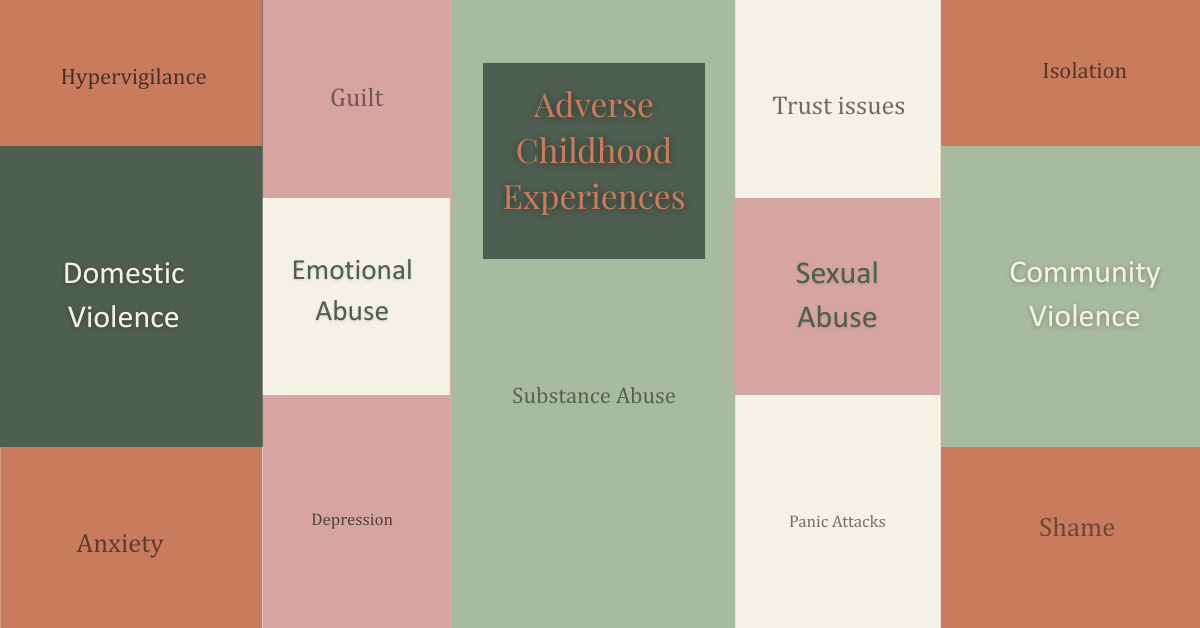

Did you know nearly two-thirds of U.S. adults report experiencing at least one adverse childhood experience? A shocking, but true statistic according to the CDC. Trauma during childhood comes from multiple areas and can have many perpetrators. Adverse Childhood Experiences (ACEs) help us understand where trauma comes from. It encompasses different types of abuse, neglect, and household dysfunction, often involving various forms of violence. Below, we will explore these categories in detail and the impact they can have.
Types of Adverse Childhood Experiences
Abuse
Abuse, a critical component of Adverse Childhood Experiences, comes in many shapes and forms. It can be physical, emotional, or sexual. It additionally includes less commonly recognized but deeply impactful forms like sibling or religious abuse. Unfortunately, these aren’t usually one-off events, although even a single traumatic incident can leave lasting scars. What does abuse look like in real life, and how do these childhood experiences manifest in adulthood?

Join our Recovery Project!
Physical Abuse
Physical abuse involves intentional bodily harm inflicted upon a child, often by someone they should be able to trust.
You were supposed to have the chicken thawed when they came home from work. When they confronted you, you flinched before they could raise their hand. Not because it ALWAYS happened, but because it sometimes did. Now, as an adult, you find yourself jumping up to appear busy. Making sure to have dinner ready and the house clean before your partner gets home.
Emotional Abuse
Emotional abuse systematically undermines a child’s self-worth, identity, and emotional well-being through consistent verbal and psychological tactics.
Don’t talk, don’t trust, don’t feel. If you do, you’re too sensitive. You’re too needy. You better suck it up, or they’ll give you something to cry about—complete disregard for your emotions and needs. As an adult, you’re afraid to express how you feel. You withdraw. You don’t speak for fear of being a burden, of being too needy, of being too emotional, and ultimately, of being abandoned.
Sexual Abuse
Sexual abuse is any non-consensual sexual act or exposure imposed on a child, violating their innocence, bodily autonomy, and developing sense of self.
You weren’t taught boundaries, and they certainly weren’t protected. Someone took advantage of your innocence. You were raped, or molested, exposed to pornography, or the subject of inappropriate conversations, or comments. As an adult, you search for love through sex. You may act promiscuously, trying to reclaim your power and control, or you may avoid sexual encounters. Lack of boundaries leaves you more susceptible to sexual manipulation and exploitation.
Sibling or Peer Abuse
When physical or emotional harm from siblings or peers becomes persistent and unchecked by adults, it creates a significant and often overlooked source of childhood trauma.
Siblings bicker, we know that. But when bickering is unbalanced, when siblings know where to hit to make it hurt, and parents dismiss behaviors as rivalry, it causes severe emotional distress. “You’re fat”, “you’re stupid”, “you’re weird”, cut like a knife and keeps twisting as we get older. Now, in adulthood, you brace yourself for physical or verbal jabs from people you trust. You believe you’re fat, you’re stupid, and you’re weird. Conflict paralyzes you and boundaries feel like a foreign language.
Religious or Cultural Abuse
Religious or cultural abuse involves the harmful manipulation, shaming, or punishment of a child, often under the guise of spiritual or traditional beliefs.
Sinners go to hell. Everything seems like a sin. Your thoughts, your actions, and your feelings. You lie in bed at night praying for forgiveness of your sins, past, present, and future, just in case. God punishes sinners, so if bad things happen, it’s because you’re bad. You learn to hate parts of yourself because you’re not obedient. You’re following the devil if you believe differently or question contradictions. As an adult, you feel lost or scared. You’re filled with existential dread and question your every decision, always wondering if you’re doing the right thing.
Neglect
Beyond overt acts of harm, a child can experience profound trauma through neglect. Neglect isn’t about what was done to a child, but what was not done for them by a caregiver. A critical failure to meet their fundamental needs. For understanding adverse childhood experiences and their effects, it’s crucial to recognize that this absence of care can be just as damaging as overt abuse, leaving deep, often invisible, scars.
The effects of childhood neglect can manifest in crucial areas of a child’s life; systematically undermining their sense of safety, value, and healthy development. Below, we’ll explore different forms of neglect and illustrate how these childhood experiences can shape an individual’s life well into adulthood.

Join our email list!
Monthly newsletter with new stories, affirmations, and more!
Physical Neglect
Physical neglect occurs when a child’s basic necessities for survival and well-being, like adequate food, shelter, clothing, or hygiene, are consistently withheld or ignored.
You go to school hungry, sometimes still skipping lunch because you don’t have money. Your classmate notices the smell of mildew and cigarettes on your clothes. You don’t remember when they were last washed. You smile without your teeth because they’re riddled with cavities. Your book bag carries all of your belongings because you do not have a home. As an adult you’re unsure how to care for yourself. You avoid the doctor, you refuse to buy new clothes even when they have holes. You exhibit unhealthy behaviors, hoarding food and household supplies, afraid you’ll run out.
Emotional Neglect
Emotional neglect is the consistent failure of caregivers to provide affection, comfort, support, or validation, leaving the child feeling unseen and unheard.
When you’re upset, in need of attention or support, you’re dismissed, or maybe your caregiver literally isn’t there. You retreat to your room to process alone. When you’re feeling discouraged, you don’t find encouragement; you’re further discouraged by the lack of support. In adulthood, we isolate. When things get difficult, our first instinct is to withdraw. We often struggle to regulate our emotions in a healthy manner. Instead, we avoid them, we numb, and we retreat.
Educational Neglect
Educational neglect is the ongoing failure of a caregiver to ensure a child receives an adequate education. Whether through non-enrollment, chronic truancy, or a lack of necessary support for learning.
You start school a year late because your parents forgot to enroll you. There is no one to help you with your homework. You’re not given the necessary tools to succeed, relying on teachers for basic supplies and having to visit the library or a friend’s house for computer/internet access. Your caregiver dismisses the importance of school. Beyond childhood, you find yourself avoiding educational spaces; you skip college. You feel disconnected in conversations, especially when others reference literature, history, or their formal education. You have low self-esteem, believing you’re “not smart enough” or “bad at school”.
Supervisory Neglect
Supervisory neglect involves a caregiver’s failure to oversee and protect, leaving a child vulnerable to unsafe environments or situations.
Your mom leaves you at home alone while she works the graveyard shift. Maybe you’re taking care of your siblings while she’s gone. When you’re 12, they say it’s okay for you to drink or smoke, but only at home. Your online presence isn’t monitored, leaving you vulnerable to predators. When you’re an adult you’re afraid to ask for help. You struggle trusting that others will show up for you. If you do accept help, you often fear it’s unreliable. You’d much rather do things yourself because it’s safer that way.
Medical Neglect
Medical neglect occurs when a caregiver delays, denies, or fails to provide necessary medical or dental care for a child, putting their physical health at risk.
You break your arm, your mom says, “stop being a baby”. It’s days before you finally convince her to take you to the doctor. It’s not until family members or friends express concern that it’s taken seriously. “It’s too expensive, you’re being dramatic”, they say. And you believe them. As an adult, you begin to ignore and dismiss your symptoms. You struggle to name your pain, thinking “it’s not bad enough”. You feel ashamed of needing help and avoid medical appointments for these reasons.
Household Dysfunction
Beyond direct abuse or neglect, a child’s home environment can profoundly shape their development. Household dysfunction, a key category in understanding Adverse Childhood Experiences (ACEs), refers to chronic challenges within a child’s living situation that create instability, fear, or a lack of predictable care. These ongoing disruptions, often invisible to outsiders, can be just as impactful as overt acts of harm, fundamentally altering a child’s sense of security and belonging.
- Domestic Violence
- Parental Substance Abuse
- Mental Illness in the Household
- Parental Separation or Divorce
- Incarcerated Family Member
- Financial Instability

Domestic Violence
Witnessing domestic violence means a child’s home, which should be their safest haven, becomes a place of fear, conflict, and unpredictable chaos.
They throw things at each other: harsh words, ashtrays, and fists. Fighting is normal; you’re just never sure how far it will go. You watch the people who are supposed to love and protect you tear each other down mentally and physically. In adulthood, you’re hypervigilant. Constantly scanning your environment, even safe ones, for danger. You can gravitate toward controlling or dangerous partners. Your overwhelmed by persistent sadness and anxiety. Panic attacks, flashbacks, and nightmares show up. You feel on edge nearly all the time, especially during conflict.
Parental Substance Abuse
Living with a caregiver who struggles with alcohol or drug addiction often means an unpredictable and chaotic environment.
You never knew which version of your parent you’d get. Would they be loving and attentive, or distant and angry? You learned to walk on eggshells, constantly monitoring their mood and behavior, perhaps even taking on adult responsibilities far too young to try and keep things stable. Sometimes you’d find them passed out, or they’d simply disappear for days. As an adult, you can find yourself acting overly responsible. You’re struggling to trust others, or constantly seeking control in your relationships. You can develop a high tolerance for dysfunction, or conversely, an intense aversion to any hint of instability, making it difficult to form healthy, balanced connections.
Mental Illness in the Household
Growing up with a caregiver experiencing severe mental health challenges, especially if untreated, can be deeply confusing and isolating for a child.
Your parent sometimes seemed “different.” One day they were full of energy, the next they couldn’t get out of bed for weeks, or they’d express unusual thoughts that scared you. You might have felt responsible for their moods, or tried to hide their struggles from others, carrying a heavy secret. You likely craved a consistent, emotionally present caregiver but rarely found it. In adulthood, you might struggle with your own mental health, fear vulnerability, or hesitate to seek professional help. You may have difficulty regulating your emotions or forming secure attachments, feeling a chronic sense of loneliness or misunderstanding.
Parental Separation or Divorce
The significant disruption and emotional impact of parental separation, particularly when it’s high-conflict, can profoundly affect a child’s sense of stability and belonging.
Suddenly, your home was split. Maybe there were loud arguments, tension, or endless discussions about who you’d live with. You might have felt caught in the middle, pressured to choose sides, or blamed yourself for the family breaking apart. Your routines shattered, and you were forced to adapt to two different households. As an adult, you may struggle with commitment in relationships, fearing abandonment or inevitable failure. You might have difficulty resolving conflict, or, conversely, become a people-pleaser to avoid discord, always seeking external validation to feel secure.
Incarcerated Family Member
Having a household member, especially a parent, who has been incarcerated can be a deeply traumatic experience, leading to sudden loss, shame, and disruption.
One day, they were there, and the next, they were gone. The family atmosphere changed instantly – sadness, anger, confusion, and whispers. You might have felt abandoned, ostracized by peers, or pressured to keep the reason a secret. Visits were difficult, leaving you with a profound sense of injustice and longing. As an adult, you might struggle with feelings of shame or stigma, leading to secrecy or difficulty trusting authority figures. You may experience abandonment issues, or feel a deep sense of loss and injustice, affecting your ability to form stable, long-term relationships and feel secure in the world.
Financial Instability
Chronic and severe financial stress within the household can create a constant undercurrent of anxiety and insecurity for a child.
Money was always a source of tension. You witnessed arguments about bills, felt the stress when food ran low, or experienced the shame of having utilities disconnected. You might have gone without basic necessities, or felt immense pressure to save money, even at a young age. Moving frequently due to eviction or being unable to afford stable housing might have been your reality. As an adult, you might develop a deep-seated anxiety about money, leading to extreme frugality or, conversely, impulsive spending. You may struggle with a pervasive sense of insecurity, fearing loss and never quite feeling stable, even when financially secure.
Community and World Violence
Too many children are exposed to violence before their brains can understand the concept. Though, not a technical category for Adverse Childhood experiences, Community and world violence can also become a profound source of trauma. This encompasses exposure to widespread acts of aggression, conflict, or systemic brutality, which can deeply erode a child’s sense of safety and future. This can include living in neighborhoods plagued by high rates of homicide or gang violence, witnessing armed conflicts, or being impacted by acts of war or genocide.
For children in these circumstances, the threat is ever-present and pervasive. Sirens, gunshots, the disappearance of neighbors, or news of distant atrocities become a constant backdrop to their daily lives. Unlike isolated incidents, this type of violence often offers no clear escape or immediate resolution, leading to a pervasive state of toxic stress. As an adult, you might experience chronic anxiety, a profound distrust of societal institutions, or a heightened sense of vulnerability. You can struggle with emotional numbness, survivor’s guilt, or a deep-seated belief that the world is inherently dangerous, impacting your ability to thrive even in safer environments.
Impact of Adverse Childhood Experiences
ACEs can affect health, well-being, and life advancement well into adulthood. The aftermath of trauma can hinder opportunities in job potential and education. Increased potential for injury, STI’s and teen pregnancy coming from high risk behavior is another commonality. The most shocking consequence is the direct impact on physical health. Individuals exposed to these traumatic experiences are at increased risk of developing things like autoimmune disease and cancer. With risk of heart disease and cancer almost doubling with an ACE score of 4.
Find out your ACE score
How many Adverse Childhood Experiences did you have?
Chronic exposure to physical and psychological trauma can cause even more trouble. Environmental and social settings, such as living in communities with violence or living in poverty, can cause toxic stress. Toxic stress from ACEs can cause negative changes in the stress-response systems, brain development and immune systems. These challenges lead to further stress in learning and attention.
Forming healthy relationships after toxic stress is difficult. As is keeping a job, managing finances and caring for oneself. These effects lead to a generational cycle. When the adult does not seek help, they pass this dysfunction to their own children. Trauma through generations can alter genetics leading to predisposition of things like heart disease, cancer and stroke.
Final Thoughts
This can all sound scary, but there is hope in knowledge. According to the CDC, we have the potential to lower the incidence in some leading causes of death by decreasing the instance of ACEs. Healing is the way forward, mentally and physically. And there is help available. Be sure to check out our wellness tips. If you relate to the information you’ve read and want to learn more check out this article by the CDC. If you’re struggling with mental health or substance use issues and need help, reach out to SAMHSA. Be good to yourself today and every day.

Need further information?
Want more info on the consequences of ACEs?