Part 2 of a 4 part series on Grief, find more here.
Over the past year, my world didn’t just crack, it shattered. It wasn’t just a single event, but a relentless culmination of losses. My identity, my stability, my core relationships, and future dreams faded away. And despite my best efforts, I wasn’t prepared for the emotional wreckage I would be left with. I found myself dazed and confused by all of the feelings. I didn’t recognize it at first, because it didn’t look like “grief” as I knew it. There was no funeral, no single marker, just a quiet unraveling of self. What I thought was consequences of a wrong decision, was something far more complicated. It was compound grief; the silent, overwhelming weight of grieving everything, all at once, without a clear end in sight.
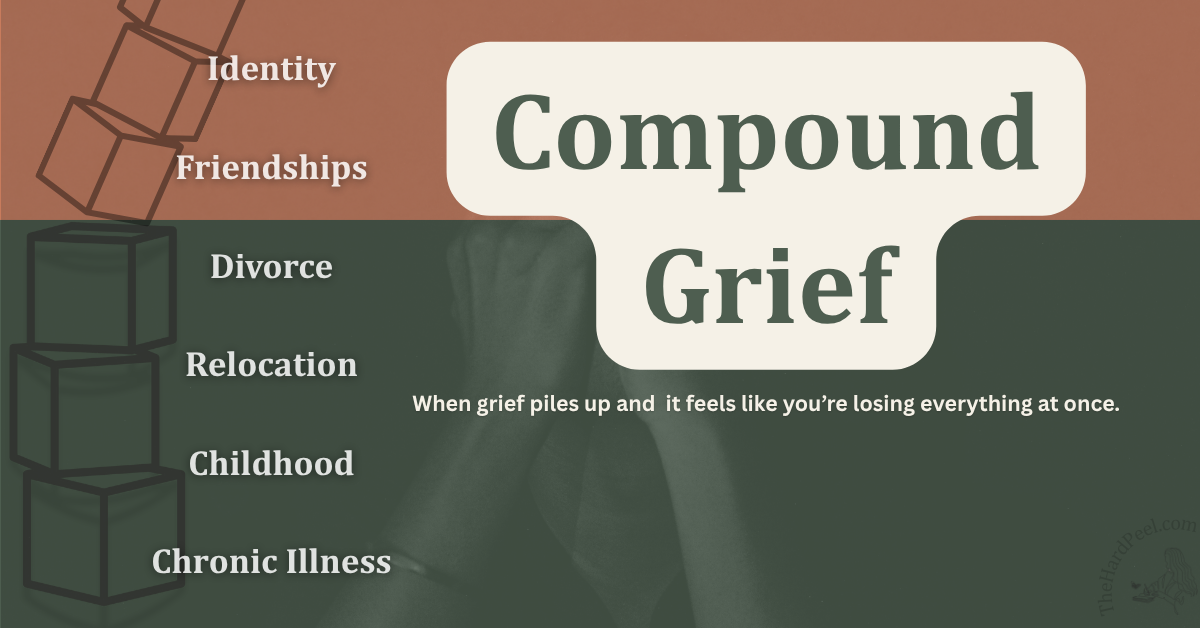
Compound grief, sometimes called cumulative grief, isn’t the single shot to the heart we typically understand. It’s an emotional avalanche, triggered by multiple losses piling up. Often these losses happen in rapid succession or before you’ve had a chance to process the one before. Think divorce, job loss, relocation, the quiet death of friendships, or even shifts in identity and purpose.
Unlike the focused sorrow after death, compound grief arrives subtly. It disguises itself as persistent burnout, irritability, and internal resistance. Or it shows up as physical symptoms like fatigue and insomnia. There’s no memorial, no sign, and no fruit basket declaring, “This is grief.”
Instead, your nervous system gets completely overwhelmed, a familiar feeling to those from trauma. You feel paralyzed, disconnected, or you’re on high alert, anticipating the next loss. Each unprocessed layer of loss compounds the next. This makes it harder to heal, to breathe, and to simply be yourself.
The ending of my marriage, loss of my home, long-held friendships, and the identity I built my strength around are the compounds of my grief. Add in the gnawing anticipatory grief for my father’s declining health and the intense unpacking of childhood trauma, it’s no surprise my soul feels heavy. None of these losses arrived with an obituary, but each one buried me deeper in the suffocating mix of shame, abandonment, sadness, and anger.
How Compound Grief Shows Up
This unnamed grief first manifested as intense burnout, not the kind a long weekend can cure. But a deep exhaustion seated in the soul, filling you with dread as you wake up. My job, once a passion, felt like a prison. I wasn’t lazy or ungrateful; my spirit was screaming for space to feel, and the whole world refused to pause.
Then came an almost physical resistance to movement. My body rebelled against walks, stretches, anything that might stir the buried sorrow. It felt like a deep, internal injury, demanding stillness as a way to protect my wounds. “We’re wounded. Don’t move,” my soul commanded.
Withdrawal followed. Hiding felt like a shield against future rejection, a way to deny the current wounds. Subconsciously, I feared that acknowledging these losses would turn me into a full-time victim. It’s tricky, embracing a victim mindset. It can offer temporary safety, a way to gain validation and be seen in suffering. Yet, it’s a deceptive comfort that can quickly become an addiction.
Compound grief rarely presents with obvious tears. Instead, it weaponizes avoidance and self-sabotage, as seen in the ways we disconnect from ourselves and others. It is, quite simply, grief without a name tag. But finding that name is the critical first step toward reclaiming your power.
Why This Type of Grief is So Hard to Name
Grief is often misunderstood, especially when it doesn’t follow a death. Society tends to recognize grief only when it’s tied to funerals, obituaries, and memorials. But what about the losses of relationships, identity, stability, or even hope? These significant shifts can elicit a deep grief, yet without a tangible “event,” we struggle to validate it.
A WebMD survey highlights this disconnect, 88% of people who experienced grief due to a life event reported emotional symptoms. With sadness and depression being the most common. It further revealed those who lost friendships/relationships experienced depression, anger, and withdrawal at higher rates than those grieving the death of a loved one. Astonishingly, many don’t connect these symptoms to grief until they begin to disrupt daily life, or in my case, sense of self.
My first clue wasn’t sorrow; it was the return of self-criticism. Suddenly, the voice in the mirror sneered, “You’re disgusting.” Mistakes began triggering an overwhelming shame. Destructive patterns I’d spent years in therapy dismantling resurfaced. This wasn’t burnout or simple lack of motivation; it was grief, deeply hidden, even from myself.
Unnamed grief becomes a silent master. It manifests as corrosive self-doubt, persistent shame, and a slow, agonizing disconnection from our bodies and worth. Because it defies the tidy boxes of “traditional” grief, we deny ourselves permission to feel it. And even if we acknowledge it, we rarely make the necessary space or time. After all, life demands we keep moving and producing, right?
What’s Helping Me Cope
Naming the grief has changed things. The moment I understood my depression and crushing exhaustion were not personal failures, but symptoms of compound grief, the self-blame began to dissolve. My focus shifted from “fixing what’s wrong with me” to compassionately tending to myself.
I’ve doubled down on my established coping mechanisms: consistent therapy, regular support groups, and dedicated journaling. This blog has also become a vital processing space where I feel seen and understood. The value of these five years of recovery work is now becoming clear; these tools are my anchors. The sheer relief of simply understanding why I feel this way has lifted an immense weight.
It’s perplexing the way our brains shield us from the source of our suffering. It leads us to frantically search for solutions in our current environment when the pain originates from months, or even years, prior. I’ve realized, once again, that I am not broken. I am simply grieving—for the life I lost, the relationships that ended, the home that vanished, and the identity that evaporated.
With this grief comes the inevitable question, “What will my life be now?” But coping isn’t about having all the answers. It’s about choosing to stay present with the questions, granting permission to feel, to rest, and to rebuild at my own pace. And for today, that is enough.
You’re Not Alone
If you’re feeling low and can’t quite explain why, if your depression doesn’t seem to match your current circumstances, you’re not alone.
What we label “depression” is often unnamed grief; pain pushed aside because life, and society, demanded we keep going. There’s no prescribed adjustment period, no ritual, no societal recognition for the deep, cumulative losses.
We’re expected to show up, be present, keep moving. And we do, until our bodies, minds, and spirits declare, “Enough.” But here’s the truth you need to internalize:
Your grief is valid.
Your healing requires no external permission.
You never have to justify your pain to deserve boundless compassion.
I’m still navigating this terrain, still healing, still learning to honor what’s been lost. All while gently making space for what comes next. If you’re grieving quietly, carrying this heavy, unnamed weight, I see you. You are not alone.
Part 1 of a 4 part series on grief, find more here.
The term anticipatory grief captures a unique and often hidden struggle. It’s the profound sorrow and anxiety we feel in anticipation of a loss, particularly when a loved one is battling a long-term illness or addiction. It’s a type of grief that arrives early, before the final goodbye, leaving us to navigate a landscape of uncertainty and profound emotion. My journey into understanding this deeply personal anguish began unexpectedly almost five years ago when my father’s health took a sudden turn, and my body reacted as if the worst had already occurred.
He had a heart attack and was going to have bypass surgery. My body and brain seemed to mistake that information for death. It felt like my heart was being ripped out of my chest. It was the type of anguish that feels like a vice around your throat. And the only other time I’ve experienced that was when my best friend suddenly died. But he wasn’t dead.
Nevertheless, my body continued to react as if he had. Or as if death was at his front door letting itself inside with a key. I would think of all the things that reminded me of him, and how we connected throughout the years. Then I tortured myself by replaying all of those memories over and over again. I added to that chaos by trying to carry his pain, to the point of breathing deeper when I’m around him, as if my oxygen will fill his lungs.
Since then, anticipatory grief has come in waves just like any other grief. Each time he’s in the hospital, it comes crashing down. His first hospitalization post-surgery actually brought about a panic attack. It made me fear how I would handle his actual death. Thankfully, I still don’t know how I’ll react to that. It feels like a type of emotional preparation or strength and conditioning. Much like a marathoner would train for a race, I’m conditioning my body to feel that grief.
What Does Anticipatory Grief Refer to?
Anticipatory grief refers to the emotional distress we experience in anticipation of an impending loss. Most commonly in death, but also surfacing in other life events, like divorce and job loss. Even the anticipation of relocating can trigger this type of grief to appear. This is because our minds and bodies are wired to perceive change as a potential threat. This prompts them to activate our protective responses.
Unfortunately, the protection they offer looks like intense feelings of sadness, anxiety, and more fear. That can make us feel powerless. Because of that, it’s important to remember that this is a normal response to impending loss. The thing about loss is you don’t always know when it’s coming. So, you may experience the anticipation for a few days to decades. Unfortunately, when your loved one suffers from addiction, the anticipatory grief experience can be far more intense.
Anticipatory Grief In The Context of Substance Use Disorders
If you love someone suffering from addiction, you’re familiar with the constant uncertainty and fear of loss. With our loved ones facing a greater potential for death, we experience prolonged periods of emotional distress and grief before an actual death occurs. This sometimes involves grieving who they were before their addiction. When someone we care for is in active addiction, each phone call and knock at the door can feel like the moment everything falls apart.
That fear, of overdose, accident, arrest, or disappearance, can trigger this grief inside us. We quickly shift to mourning outcomes that have yet to come. Our grief is exacerbated by the sense of helplessness and lack of control we have over their addiction. We want to fix it, but we’re often in such a state of emotional distress that we’re too paralyzed to even take care of ourselves.
Anticipatory Grief: How to Cope
The first step in coping with anticipatory grief is to acknowledge and accept your feelings. No matter how silly, how big, or how painful, it’s imperative that we feel them. Even when they’re difficult, when we suppress these emotions, we’re telling our bodies and brains that it’s not safe to feel. This leads to further internal disconnection and a cycle of avoidance. So, let me say this again—
Anticipatory grief is a normal response, and your feelings are valid.
Discussing these feelings and experiences can also help. Support groups, friends, family, and therapists are excellent resources when coping with anticipatory grief and addiction. Social connection activates the release of oxytocin. This release helps with regulating stress and fosters emotional resilience, both of which are important in processing grief.
Another way we can cope is by preparing for the future. While much about impending loss feels out of our hands, shifting our focus to what is within our control can be incredibly empowering. Use your energy to make practical arrangements, such as setting up a will or pre-planning the funeral. If those things don’t seem like the right fit, simply discussing the future and what it might hold can prove beneficial.
Final Thoughts
The experience of anticipatory grief is a testament to our profound capacity to love, even in the face of deep uncertainty. Whether you’re anticipating a loss due to illness, addiction, or any other life transition, remember that your feelings—no matter how intense or confusing—are valid. You’re not alone in feeling this unsettling mix of sadness, fear, and love. By acknowledging these emotions, connecting with your support network, and giving yourself permission to feel without judgment, you are building resilience. It’s a continuous journey, but with each step of self-compassion and understanding, you empower yourself to navigate these difficult waters.
There are no villains in my story. There are, however, a lot of victims. Bad people didn’t do bad things to me. But bad things did happen to me, often by the direct hand of another.
Bear with me, I promise I’m not contradicting myself.
The bad things I experienced didn’t come from perfect people because they don’t exist either. They came by the hands of people that experienced similar at another point in time. People that hurt in the same ways I hurt. Behaviors and actions do not determine the amount of good or bad someone is. But they do have a story to tell if you listen.
I have to believe in the idea that there are no bad people or parts. I have to believe in it because if I don’t, I’ll be a villain in my own story. None of us are above causing harm. No matter how good you claim to be, how hard you work on yourself, or how much you pray. Even the kindest people, the ones that “want the best for you” can inflict harm. It’s not our intention to do so. At least not our conscious intention.
I’m finding there is a part of me that is a little less kind. That is a little more conniving and, my goodness, is it stealthy. The intention with this part IS to inflict harm. On their abuser and anyone that appears similarly. They want revenge. They’ve referred to themself as a “vengeful martyr.”
Let’s all laugh at the accuracy of that name.
The vengeful martyr is the part that says the nasty thing to you when my feelings are hurt. It’s the part that’s cheated and lied. But it’s also the part to say yes only to hold a passive resentment. The part that gives you the silent treatment. It ghosts you. It’s the part that pushes everyone away.
What seems like justice and protection to this part appears as self-destruction and abuse to those in my current reality. Whether it’s a bold lashing out to the original perpetrators or just holding quiet contempt for others we find similar, it’s a slippery slope. That part is no longer qualified to be the judge and jury of anyone. But there’s a lot of anger there. And even more fear. So now I get to learn how to release that anger and ease the fear.
Let’s not confuse any of this with letting people off the hook. People are still responsible for the harm they cause. In a sense, this is letting me take responsibility for some of the harm I’ve caused. If I can build a connection with this vengeful martyr and provide it with the validation it needs, I’m sure we’ll find less contempt and be able to offer more compassion.
In my experience? Every day. It’s remarkable how the human brain adapts to survive, especially when faced with childhood trauma. But sometimes, the very survival skills we develop as children can become invisible barriers in our adult lives. I wake up feeling exhausted after fighting for my life in my dreams all night. I can’t find anything to wear that matches my perfectionism, and a voice echoes, “Are you f*cking stupid?”. Then I get a text from my boss-
‘Do you have a second for a call?’
Oh God, my heart races and my face flushes. I’m going to be fired. What did I do wrong? Where did I mess up? What’s my excuse? I skip lunch because the act of choosing a meal is too much. It’s loaded with guilt, indecision, and the fear of getting it wrong.
When my partner works late, my mind gets creative. It considers worst-case scenarios and seeks evidence to back the claims. I’ll obsessively review past conversations and behaviors to confirm my suspicions. By the time they arrive home, I’ve built up a resentment based on inaccuracies and fear.
Signs of childhood trauma can be subtle or down right crude. And if you grew up in a dysfunctional home, you’re probably feeling the effects right now. We struggle in our relationships, work, finances, and beyond. Childhood abuse and neglect disrupts normal development and learning in many areas, making adulthood seem harder than it should be. We’ll explore some of these below.
Psych2go-Additional Signs of Childhood Trauma in Adulthood
How Childhood Trauma Affects Relationships
From trust issues and a lack of boundaries, we’re often destined to have difficulty creating and maintaining healthy relationships. In my early adulthood, this looked like co-dependency, jealousy, people-pleasing, and over-functioning. I would say yes when I meant no because I was afraid of being abandoned. I would over-extend myself because in childhood I learned love is performance based. Because I lacked boundaries and had no understanding of my own values, I found myself in many chaotic situations.
Chaotic or Unfulfilling Relationships
Many people from traumatic childhoods find it difficult to trust in relationships. Past betrayal and abandonment can have us on high alert. Coincidentally, we can choose a partner that triggers this wound within us or confirms our suspicions. And because we feel comfortable in chaos, we will mistake that excitement for love. Inhibited emotional regulation can worsen issues within the relationship when difficult discussions end with intense reactions. Furthermore, this lack of control can lead to issues in basic communication. A crucial part of relationships.
People-Pleasing and Over-functioning
In childhood, we often found ourselves caring for those around us. Our needs were pushed aside, and focus shifted to fixing the problems of our dysfunctional household. We received praise when we performed well, and subsequently learned to associate performance with having our needs met. Instead of verbally expressing our needs, we over-function in our relationships. We act, not out of kindness or love, but out of survival. We’re afraid if we don’t perform or agree, we’ll be abandoned.
Setting & Maintaining Boundaries
We struggle with setting and maintaining boundaries because we were never taught what they were. Our physical, intellectual, and emotional boundaries were crossed nearly daily. We were taught that our needs were secondary, inconvenient, or even dangerous. Saying “no” was sometimes met with punishment, guilt, or emotional withdrawal. This reinforced our idea that self-protection meant rejection.
These early experiences taught us that love had to be earned through compliance, that asserting independence was considered rebellion, and that prioritizing ourselves was selfish. As adults, we feel guilt, anxiety, and fear when trying to set limits. We do this in an attempt to avoid the consequences we once faced for simply being ourselves.
Become a Peeler!
Join our community and sign up for our newsletter for deeper connection.
Intense emotional shifts can feel overwhelming. One moment, you’re on top of the world; the next, you’re deep in your own personal hell. Feelings like shame, guilt, fear, anger, and sadness can completely take over. When those heavy feelings finally lift, there’s often a rush of euphoria, a natural response after feeling so low for so long. Early in my adulthood, lost in despair, I often looked at my life and wondered why I couldn’t shake the sadness and irritability. I described it as being on a roller coaster, highs filled with anxiety, and lows that took my breath away or made me want to give up entirely. I later realized the deep, ongoing sadness I was experiencing had less to do with what was happening around me and much more to do with what was happening inside.
Chronic Guilt and Shame
Childhood trauma leaves a chronic sense of guilt and shame. For many adults, this feeling isn’t loud. But beneath daily decisions, it quietly influences how you speak, love, and care for yourself. It looks like over-apologizing for things that weren’t your fault. It’s agonizing over simple choices, like what to eat for lunch. It’s feeling undeserving of rest unless you’ve “earned” it through productivity. Shame might show up as isolation, perfectionism, or even the inability to ask for help without guilt. These patterns often feel invisible from the outside, but internally they create a constant loop of self questioning. Where every need is scrutinized and every emotion feels like a burden.
Fear of Conflict
Childhood trauma can instill a deep, silent fear of conflict that profoundly impacts adult relationships. For many, this isn’t about running from big arguments; it’s a subtle urge to avoid even the slightest disagreement. It shapes how you talk, express your needs, and react when things get tough. This looks like always saying yes, even when you mean no, just to keep the peace. It’s walking on eggshells, carefully picking words to avoid upsetting anyone, even when simply sharing an idea.
There’s a surge of panic facing even minor disagreements, leading you to completely shut down or give in immediately. This fear can show up as always trying to please others, being overly passive, or finding it impossible to set healthy limits without feeling intense worry. These patterns often create a seemingly calm life on the outside, but inside, they lead to resentment, unmet needs, and a constant stifling of your true self.
Emotional Instability
You spend days in bed consumed by depression, then you’re excited by a new project or plan. The shifts are so drastic you question your sanity at times. This dramatic roller coaster of emotion, which can include overwhelming feelings of shame, guilt, fear, anger, and sadness, sometimes leads to a misdiagnosis of mood disorders like borderline personality disorder or bipolar disorder. When emotions feel out of control, you can find yourself acting impulsively or compulsively. Overspending or turning to substance use is a common way of seeking relief. Adults who experienced childhood trauma often sway between these heightened reactions and emotional numbness. They can even unconsciously sabotage their relationships, unable to manage the intensity of genuine connection.
Anger & Aggression
If you find yourself getting angry very quickly, or feeling like your anger comes out of nowhere, you’re not alone. Unexplained anger can be a sign of deeper feelings, like anxiety or sadness, rooted in childhood experiences. Adverse Childhood Experiences (ACEs) can make a person much more likely to react with anger as an adult. These tough early experiences essentially train your brain to be on high alert all the time. This makes it much harder for your brain to calmly manage strong feelings, leading to more sudden and intense angry outbursts, even over small things.
According to a study by UCLA, individuals from childhood trauma are at increased risk for developing 20 major health disorders.
Childhood trauma leaves a mark not just on the mind, but profoundly on the body itself. These early experiences can lead to toxic stress, a prolonged and overwhelming activation of your nervous system that keeps your body stuck in a constant state of ‘fight or flight.’ This often results in hypervigilance, where you’re always on edge, scanning for danger even when none is present. Such chronic stress takes a heavy toll, significantly increasing the risk for various physical conditions, including autoimmune diseases and other chronic illnesses. In addition, many who’ve experienced trauma learn to disconnect from their bodily needs and sensations, making it incredibly difficult to recognize their own hunger, fatigue, pain, or illness until it becomes severe.
Toxic Stress
While some stress can actually be helpful or manageable, toxic stress is different and much more damaging. It forms when a child experiences strong, frequent, or long-lasting adversity, like the Adverse Childhood Experiences we’ve discussed, without the support of a caring adult to help them cope. When a child’s body is repeatedly flooded with stress hormones due to this overwhelming pressure, their developing brain and body systems are constantly on high alert. Over time, this can actually change the way their brain develops, affecting their ability to learn, manage emotions, and form healthy connections. It also wears down their immune system and other vital body systems, leading to a higher risk of many of the serious physical and mental health problems seen well into adulthood.
Autoimmune & Chronic Disease
Childhood trauma significantly impacts physical well-being as well. Trauma raises the risk for autoimmune diseases and chronic illnesses in adulthood. According to the NIH The constant state of toxic stress from adverse childhood experiences can lead to persistent inflammation and dysregulation of the body’s immune system. This means the body, already on high alert, can mistakenly begin attacking its own healthy tissues.
Research consistently shows a strong link between ACEs and a heightened risk for various conditions. For instance, individuals with four or more ACEs are more likely to develop heart disease, cancer, diabetes, chronic lung disease, and liver disease. Studies have also indicated increased prevalence of conditions like rheumatoid arthritis, lupus, fibromyalgia, and chronic fatigue syndrome among those with higher ACE scores. The Centers for Disease Control and Prevention (CDC) provides extensive research on these connections, highlighting how preventing ACEs could significantly reduce the incidence of many leading causes of death. Early adversity doesn’t just shape our stories, it leaves a mark on our biology, it reminds us that the body remembers what the mind tries to forget.
Disconnection from Bodily Needs/Sensations
When a child experiences chronic stress or abuse, their nervous system can learn to “tune out” distressing physical feelings as a coping mechanism. Childhood trauma can profoundly impact an individual’s connection to their own body, leading to a disconnection from bodily needs and sensations. This can manifest in adulthood as a surprising lack of awareness about basic bodily signals. You might consistently ignore hunger cues, push past extreme fatigue, or not notice pain until it becomes debilitating. This detachment means you can miss early signs of illness. You can struggle to identify emotional feelings as they manifest physically, or find it difficult to relax and truly feel “at home” in your own skin. This can ultimately impact self-care and overall well-being.
Problems with Focus and Attention
Struggles with attention and focus are another common challenge for adults impacted by early adversity. This isn’t just about simple absentmindedness; this affects daily life, leading to problems in careers, managing finances, and even consistent self-care. The chronic stress carried from past trauma can interfere with the brain’s processes for clear thinking and concentration. This ongoing struggle with focus can also create deep self-doubt. This further erodes confidence and makes it incredibly difficult to concentrate on and work towards future goals.
When you’ve experienced childhood trauma, your brain and body develop remarkable ways to survive. These learned survival tactics often become deeply ingrained coping behaviors in adulthood, even if you’re not fully aware of their origins. They can show up as a constant need to control your surroundings, a tendency to retreat when things get tough, or an intense pull to disappear in activities, like playing video games or overeating. These actions, once protective in a difficult past, can unintentionally become rigid patterns that keep you from true peace and connection. In the following sections, we’ll explore some common ways these coping mechanisms appear in daily life, including overworking, escapism, and perfectionism.
Overworking
Adults from childhood trauma often find themselves overworking as a way to cope with their discomforts. You can find yourself constantly busy, taking on too many tasks, or feeling an intense guilt whenever you’re not productive. For many, this isn’t just about ambition; it becomes a powerful way to avoid uncomfortable feelings, gain a sense of control, or prove their worth. You might unconsciously believe your value is tied solely to your achievements, or that staying constantly occupied will prevent painful memories and emotions from surfacing. This type of relentless striving, however, can leave you exhausted, isolated, and still yearning for the internal peace you’re trying so hard to outrun.
Escapism
Escapism often becomes a powerful coping mechanism for adults living with the effects of childhood trauma. The profound stress from these early experiences can actually alter brain development, making an individual more susceptible to addictive behaviors. You might find yourself constantly seeking out substances, doom scrolling, or binge eating. We cling to compulsive activities, or other diversions to quiet the intense discomfort that comes from feeling disconnected or to numb our emotions. Many trauma survivors turn to these forms of self medication as a way to find temporary relief. Relief from the overwhelming anxiety, depression, and self-doubt, or simply to block out painful memories.
Perfectionism
Perfectionism is another common, often exhausting, coping mechanism developed in response to childhood trauma. You might feel an intense pressure to be flawless, believing that any mistake will lead to severe negative consequences, just as it might have in your past. This isn’t about healthy ambition; it’s a deep-seated need to control outcomes and avoid criticism or rejection. It stems from environments where mistakes were punished or love felt conditional. You might spend excessive amounts of time on tasks, endlessly revise your work, or postpone starting anything new for fear it won’t be perfect. Unfortunately, this leads to constant anxiety and burnout.
Final Thoughts
The pathways we carve in childhood often shape the routes we travel as adults. Childhood trauma affects more than we frequently realize. And while these patterns were once essential to surviving, they aren’t always suited for thriving. Recognizing them isn’t a betrayal of who we were, it’s an act of care toward who we’re becoming.
If parts of this resonated with you, I invite you to sit with that feeling. Be gentle with your own unfolding. Healing isn’t a straight line, and it rarely feels like a destination. But even the act of noticing can be a new beginning.
For those exploring this path, here are a few resources that may help:
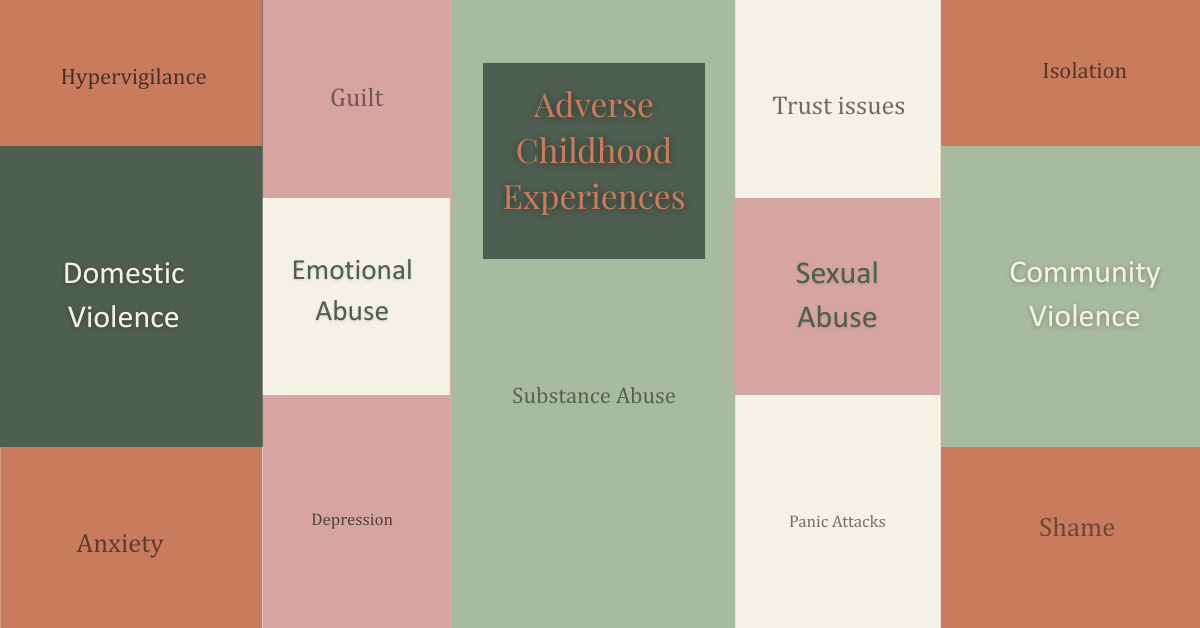
Did you know nearly two-thirds of U.S. adults report experiencing at least one adverse childhood experience? A shocking, but true statistic according to the CDC. Trauma during childhood comes from multiple areas and can have many perpetrators. Adverse Childhood Experiences (ACEs) help us understand where trauma comes from. It encompasses different types of abuse, neglect, and household dysfunction, often involving various forms of violence. Below, we will explore these categories in detail and the impact they can have.
Abuse, a critical component of Adverse Childhood Experiences, comes in many shapes and forms. It can be physical, emotional, or sexual. It additionally includes less commonly recognized but deeply impactful forms like sibling or religious abuse. Unfortunately, these aren’t usually one-off events, although even a single traumatic incident can leave lasting scars. What does abuse look like in real life, and how do these childhood experiences manifest in adulthood?
Physical abuse involves intentional bodily harm inflicted upon a child, often by someone they should be able to trust.
You were supposed to have the chicken thawed when they came home from work. When they confronted you, you flinched before they could raise their hand. Not because it ALWAYS happened, but because it sometimes did. Now, as an adult, you find yourself jumping up to appear busy. Making sure to have dinner ready and the house clean before your partner gets home.
Emotional Abuse
Emotional abuse systematically undermines a child’s self-worth, identity, and emotional well-being through consistent verbal and psychological tactics.
Don’t talk, don’t trust, don’t feel. If you do, you’re too sensitive. You’re too needy. You better suck it up, or they’ll give you something to cry about—complete disregard for your emotions and needs. As an adult, you’re afraid to express how you feel. You withdraw. You don’t speak for fear of being a burden, of being too needy, of being too emotional, and ultimately, of being abandoned.
Sexual Abuse
Sexual abuse is any non-consensual sexual act or exposure imposed on a child, violating their innocence, bodily autonomy, and developing sense of self.
You weren’t taught boundaries, and they certainly weren’t protected. Someone took advantage of your innocence. You were raped, or molested, exposed to pornography, or the subject of inappropriate conversations, or comments. As an adult, you search for love through sex. You may act promiscuously, trying to reclaim your power and control, or you may avoid sexual encounters. Lack of boundaries leaves you more susceptible to sexual manipulation and exploitation.
Sibling or Peer Abuse
When physical or emotional harm from siblings or peers becomes persistent and unchecked by adults, it creates a significant and often overlooked source of childhood trauma.
Siblings bicker, we know that. But when bickering is unbalanced, when siblings know where to hit to make it hurt, and parents dismiss behaviors as rivalry, it causes severe emotional distress. “You’re fat”, “you’re stupid”, “you’re weird”, cut like a knife and keeps twisting as we get older. Now, in adulthood, you brace yourself for physical or verbal jabs from people you trust. You believe you’re fat, you’re stupid, and you’re weird. Conflict paralyzes you and boundaries feel like a foreign language.
Religious or Cultural Abuse
Religious or cultural abuse involves the harmful manipulation, shaming, or punishment of a child, often under the guise of spiritual or traditional beliefs.
Sinners go to hell. Everything seems like a sin. Your thoughts, your actions, and your feelings. You lie in bed at night praying for forgiveness of your sins, past, present, and future, just in case. God punishes sinners, so if bad things happen, it’s because you’re bad. You learn to hate parts of yourself because you’re not obedient. You’re following the devil if you believe differently or question contradictions. As an adult, you feel lost or scared. You’re filled with existential dread and question your every decision, always wondering if you’re doing the right thing.
Neglect
Beyond overt acts of harm, a child can experience profound trauma through neglect. Neglect isn’t about what was done to a child, but what was not done for them by a caregiver. A critical failure to meet their fundamental needs. For understanding adverse childhood experiences and their effects, it’s crucial to recognize that this absence of care can be just as damaging as overt abuse, leaving deep, often invisible, scars.
The effects of childhood neglect can manifest in crucial areas of a child’s life; systematically undermining their sense of safety, value, and healthy development. Below, we’ll explore different forms of neglect and illustrate how these childhood experiences can shape an individual’s life well into adulthood.
Physical neglect occurs when a child’s basic necessities for survival and well-being, like adequate food, shelter, clothing, or hygiene, are consistently withheld or ignored.
You go to school hungry, sometimes still skipping lunch because you don’t have money. Your classmate notices the smell of mildew and cigarettes on your clothes. You don’t remember when they were last washed. You smile without your teeth because they’re riddled with cavities. Your book bag carries all of your belongings because you do not have a home. As an adult you’re unsure how to care for yourself. You avoid the doctor, you refuse to buy new clothes even when they have holes. You exhibit unhealthy behaviors, hoarding food and household supplies, afraid you’ll run out.
Emotional Neglect
Emotional neglect is the consistent failure of caregivers to provide affection, comfort, support, or validation, leaving the child feeling unseen and unheard.
When you’re upset, in need of attention or support, you’re dismissed, or maybe your caregiver literally isn’t there. You retreat to your room to process alone. When you’re feeling discouraged, you don’t find encouragement; you’re further discouraged by the lack of support. In adulthood, we isolate. When things get difficult, our first instinct is to withdraw. We often struggle to regulate our emotions in a healthy manner. Instead, we avoid them, we numb, and we retreat.
Educational Neglect
Educational neglect is the ongoing failure of a caregiver to ensure a child receives an adequate education. Whether through non-enrollment, chronic truancy, or a lack of necessary support for learning.
You start school a year late because your parents forgot to enroll you. There is no one to help you with your homework. You’re not given the necessary tools to succeed, relying on teachers for basic supplies and having to visit the library or a friend’s house for computer/internet access. Your caregiver dismisses the importance of school. Beyond childhood, you find yourself avoiding educational spaces; you skip college. You feel disconnected in conversations, especially when others reference literature, history, or their formal education. You have low self-esteem, believing you’re “not smart enough” or “bad at school”.
Supervisory Neglect
Supervisory neglect involves a caregiver’s failure to oversee and protect, leaving a child vulnerable to unsafe environments or situations.
Your mom leaves you at home alone while she works the graveyard shift. Maybe you’re taking care of your siblings while she’s gone. When you’re 12, they say it’s okay for you to drink or smoke, but only at home. Your online presence isn’t monitored, leaving you vulnerable to predators. When you’re an adult you’re afraid to ask for help. You struggle trusting that others will show up for you. If you do accept help, you often fear it’s unreliable. You’d much rather do things yourself because it’s safer that way.
Medical Neglect
Medical neglect occurs when a caregiver delays, denies, or fails to provide necessary medical or dental care for a child, putting their physical health at risk.
You break your arm, your mom says, “stop being a baby”. It’s days before you finally convince her to take you to the doctor. It’s not until family members or friends express concern that it’s taken seriously. “It’s too expensive, you’re being dramatic”, they say. And you believe them. As an adult, you begin to ignore and dismiss your symptoms. You struggle to name your pain, thinking “it’s not bad enough”. You feel ashamed of needing help and avoid medical appointments for these reasons.
Household Dysfunction
Beyond direct abuse or neglect, a child’s home environment can profoundly shape their development. Household dysfunction, a key category in understanding Adverse Childhood Experiences (ACEs), refers to chronic challenges within a child’s living situation that create instability, fear, or a lack of predictable care. These ongoing disruptions, often invisible to outsiders, can be just as impactful as overt acts of harm, fundamentally altering a child’s sense of security and belonging.
Witnessing domestic violence means a child’s home, which should be their safest haven, becomes a place of fear, conflict, and unpredictable chaos.
They throw things at each other: harsh words, ashtrays, and fists. Fighting is normal; you’re just never sure how far it will go. You watch the people who are supposed to love and protect you tear each other down mentally and physically. In adulthood, you’re hypervigilant. Constantly scanning your environment, even safe ones, for danger. You can gravitate toward controlling or dangerous partners. Your overwhelmed by persistent sadness and anxiety. Panic attacks, flashbacks, and nightmares show up. You feel on edge nearly all the time, especially during conflict.
Parental Substance Abuse
Living with a caregiver who struggles with alcohol or drug addiction often means an unpredictable and chaotic environment.
You never knew which version of your parent you’d get. Would they be loving and attentive, or distant and angry? You learned to walk on eggshells, constantly monitoring their mood and behavior, perhaps even taking on adult responsibilities far too young to try and keep things stable. Sometimes you’d find them passed out, or they’d simply disappear for days. As an adult, you can find yourself acting overly responsible. You’re struggling to trust others, or constantly seeking control in your relationships. You can develop a high tolerance for dysfunction, or conversely, an intense aversion to any hint of instability, making it difficult to form healthy, balanced connections.
Mental Illness in the Household
Growing up with a caregiver experiencing severe mental health challenges, especially if untreated, can be deeply confusing and isolating for a child.
Your parent sometimes seemed “different.” One day they were full of energy, the next they couldn’t get out of bed for weeks, or they’d express unusual thoughts that scared you. You might have felt responsible for their moods, or tried to hide their struggles from others, carrying a heavy secret. You likely craved a consistent, emotionally present caregiver but rarely found it. In adulthood, you might struggle with your own mental health, fear vulnerability, or hesitate to seek professional help. You may have difficulty regulating your emotions or forming secure attachments, feeling a chronic sense of loneliness or misunderstanding.
Parental Separation or Divorce
The significant disruption and emotional impact of parental separation, particularly when it’s high-conflict, can profoundly affect a child’s sense of stability and belonging.
Suddenly, your home was split. Maybe there were loud arguments, tension, or endless discussions about who you’d live with. You might have felt caught in the middle, pressured to choose sides, or blamed yourself for the family breaking apart. Your routines shattered, and you were forced to adapt to two different households. As an adult, you may struggle with commitment in relationships, fearing abandonment or inevitable failure. You might have difficulty resolving conflict, or, conversely, become a people-pleaser to avoid discord, always seeking external validation to feel secure.
Incarcerated Family Member
Having a household member, especially a parent, who has been incarcerated can be a deeply traumatic experience, leading to sudden loss, shame, and disruption.
One day, they were there, and the next, they were gone. The family atmosphere changed instantly – sadness, anger, confusion, and whispers. You might have felt abandoned, ostracized by peers, or pressured to keep the reason a secret. Visits were difficult, leaving you with a profound sense of injustice and longing. As an adult, you might struggle with feelings of shame or stigma, leading to secrecy or difficulty trusting authority figures. You may experience abandonment issues, or feel a deep sense of loss and injustice, affecting your ability to form stable, long-term relationships and feel secure in the world.
Financial Instability
Chronic and severe financial stress within the household can create a constant undercurrent of anxiety and insecurity for a child.
Money was always a source of tension. You witnessed arguments about bills, felt the stress when food ran low, or experienced the shame of having utilities disconnected. You might have gone without basic necessities, or felt immense pressure to save money, even at a young age. Moving frequently due to eviction or being unable to afford stable housing might have been your reality. As an adult, you might develop a deep-seated anxiety about money, leading to extreme frugality or, conversely, impulsive spending. You may struggle with a pervasive sense of insecurity, fearing loss and never quite feeling stable, even when financially secure.
Community and World Violence
Too many children are exposed to violence before their brains can understand the concept. Though, not a technical category for Adverse Childhood experiences, Community and world violence can also become a profound source of trauma. This encompasses exposure to widespread acts of aggression, conflict, or systemic brutality, which can deeply erode a child’s sense of safety and future. This can include living in neighborhoods plagued by high rates of homicide or gang violence, witnessing armed conflicts, or being impacted by acts of war or genocide.
For children in these circumstances, the threat is ever-present and pervasive. Sirens, gunshots, the disappearance of neighbors, or news of distant atrocities become a constant backdrop to their daily lives. Unlike isolated incidents, this type of violence often offers no clear escape or immediate resolution, leading to a pervasive state of toxic stress. As an adult, you might experience chronic anxiety, a profound distrust of societal institutions, or a heightened sense of vulnerability. You can struggle with emotional numbness, survivor’s guilt, or a deep-seated belief that the world is inherently dangerous, impacting your ability to thrive even in safer environments.
Impact of Adverse Childhood Experiences
ACEs can affect health, well-being, and life advancement well into adulthood. The aftermath of trauma can hinder opportunities in job potential and education. Increased potential for injury, STI’s and teen pregnancy coming from high risk behavior is another commonality. The most shocking consequence is the direct impact on physical health. Individuals exposed to these traumatic experiences are at increased risk of developing things like autoimmune disease and cancer. With risk of heart disease and cancer almost doubling with an ACE score of 4.
Find out your ACE score
How many Adverse Childhood Experiences did you have?
Chronic exposure to physical and psychological trauma can cause even more trouble. Environmental and social settings, such as living in communities with violence or living in poverty, can cause toxic stress. Toxic stress from ACEs can cause negative changes in the stress-response systems, brain development and immune systems. These challenges lead to further stress in learning and attention.
Forming healthy relationships after toxic stress is difficult. As is keeping a job, managing finances and caring for oneself. These effects lead to a generational cycle. When the adult does not seek help, they pass this dysfunction to their own children. Trauma through generations can alter genetics leading to predisposition of things like heart disease, cancer and stroke.
Final Thoughts
This can all sound scary, but there is hope in knowledge. According to the CDC, we have the potential to lower the incidence in some leading causes of death by decreasing the instance of ACEs. Healing is the way forward, mentally and physically. And there is help available. Be sure to check out our wellness tips. If you relate to the information you’ve read and want to learn more check out this article by the CDC. If you’re struggling with mental health or substance use issues and need help, reach out to SAMHSA. Be good to yourself today and every day.